A finals study schedule works best when it starts 21 days before your own first exam and splits those three weeks by purpose: week one covers every topic once and finds the gaps, week two is timed practice in exam-length blocks, and week three is mixed review with a fixed bedtime. Inside each week, hours go to courses in proportion to how much the exam counts and how unsure you are. Below are fall 2026 dates from three universities, a way to divide hours between exams, the three-week calendar, and daily time grids for class days, free days, and exam days.
When fall 2026 finals start
Exam weeks differ by school, so start from your own registrar's schedule. Three examples from official fall 2026 schedules:
| School | Last class day | Final exams | Exam slot length |
|---|---|---|---|
| Auburn University | Dec 4 | Mon Dec 7 – Fri Dec 11 | 2 hours (standard slots) |
| LSU | — | Dec 7 – Dec 12 | 2 hours (no exam exceeds two hours) |
| University of Kansas | — | Dec 14 – Dec 18 | — |
Count back from the date of your first exam, not from the start of the exam period. If your first exam is Monday, December 7, day one of the plan is Monday, November 16. If it is Monday, December 14, day one is Monday, November 23. In both cases Thanksgiving Day, Thursday, November 26, lands inside the plan, so one of the three weeks will be shorter than the others.
Step 1: Divide your hours between exams
First, estimate how many study hours you really have over the 21 days on top of classes, work, and travel. Be honest; 60 hours is three weeks of about three hours a day, with a lighter Thanksgiving week.
Then give each exam a score: its share of your final grade, multiplied by how unsure you are (5 minus your confidence on a 1–5 scale, plus 1). Divide your hours in proportion to the scores. An example with four courses and 60 hours:
| Course | Exam | Share of grade | Confidence (1–5) | Score | Hours |
|---|---|---|---|---|---|
| Calculus | Dec 7 | 30% | 2 | 30 × 4 = 120 | 21 |
| Organic chemistry | Dec 10 | 35% | 3 | 35 × 3 = 105 | 19 |
| U.S. history | Dec 11 | 25% | 4 | 25 × 2 = 50 | 9 |
| Writing seminar paper | Due Dec 9 | 20% | 3 | 20 × 3 = 60 | 11 |
| Total | 335 | 60 |
The formula is only a starting point. Its job is to stop you from spending most of your time on the course you already like while the heavy, shaky one waits until the last weekend.
Step 2: The three-week calendar
Each week has a different job. Doing week two's timed practice before you have covered everything once wastes practice tests on material you have not seen; doing only week one's reading until the end leaves you with no idea how you perform under time pressure.
| Week | If first exam is Dec 7 | If first exam is Dec 14 | Focus | Study blocks per day |
|---|---|---|---|---|
| 1 | Nov 16 – Nov 22 | Nov 23 – Nov 29 | Cover every topic once, build a gap list | 2 |
| 2 | Nov 23 – Nov 29 | Nov 30 – Dec 6 | Timed practice in 2-hour blocks, fix the gaps | 2–3 |
| 3 | Nov 30 – Dec 6 | Dec 7 – Dec 13 | Mixed review, short timed sets, fixed sleep | 3 |
Thanksgiving week (November 23–29) falls in week two for the first group and in week one for the second. Plan it at one block a day, put flashcards or a reading on the travel day, and do not count on studying on Thanksgiving Day itself. Move the lost hours to the weekend before.
Step 3: Daily time grids
Use 2-hour blocks for practice exams. Standard final exam slots at Auburn and LSU are two hours long, so practicing in the same length trains the stamina you will need. Use 60-minute blocks for reading notes, flashcards, and fixing mistakes.
A class day:
| Time | Block |
|---|---|
| 08:00–08:30 | Breakfast, read yesterday's gap list |
| 09:00–12:00 | Classes |
| 12:00–13:00 | Lunch |
| 13:00–15:00 | Block 1: practice exam for the highest-score course |
| 15:00–15:30 | Break, walk outside |
| 15:30–16:30 | Class or office hours with questions from block 1 |
| 17:00–18:00 | Block 2: second course, fix errors from last practice |
| 18:00–19:00 | Dinner |
| 19:00–20:00 | Block 3 (weeks 2–3): flashcards, light review |
| 20:00–23:00 | Off |
| 23:00 | Lights out, same time every night |
A day with no classes (weekend or break):
| Time | Block |
|---|---|
| 09:00–11:00 | Practice exam, timed, no notes |
| 11:00–11:30 | Grade it |
| 11:30–12:30 | Fix every mistake, add topics to the gap list |
| 12:30–13:30 | Lunch |
| 13:30–15:30 | Second course: practice exam or paper drafting |
| 15:30–16:00 | Break |
| 16:00–17:00 | Gap list: one topic at a time |
| 17:00 onward | Off |
An exam day: one 45-minute block of light review two hours before the exam, no new material, food, then the exam. After it, take a real break of at least an hour before starting a block for the next course.
Keep the bedtime fixed through all three weeks. The CDC recommends at least 7 hours of sleep for adults 18 to 60, and 8 to 10 hours for teens 13 to 17. An all-nighter trades the next day's study blocks for one evening.
When the plan slips
- Never stack a missed block on top of tomorrow. Put it in the next free-day afternoon instead.
- Cut volume, not the block. If a practice exam will not fit, do half of it in the same slot.
- Re-score on the first day of each week. After week one you know your confidence better. Recalculate the hours for the remaining two weeks.
- Keep the phone out of the room during 2-hour blocks. Ideas for that are in how to stop checking your phone while studying.
For the general method behind study blocks, see time-boxing for students, and for a full semester weekday layout, the college student schedule template.
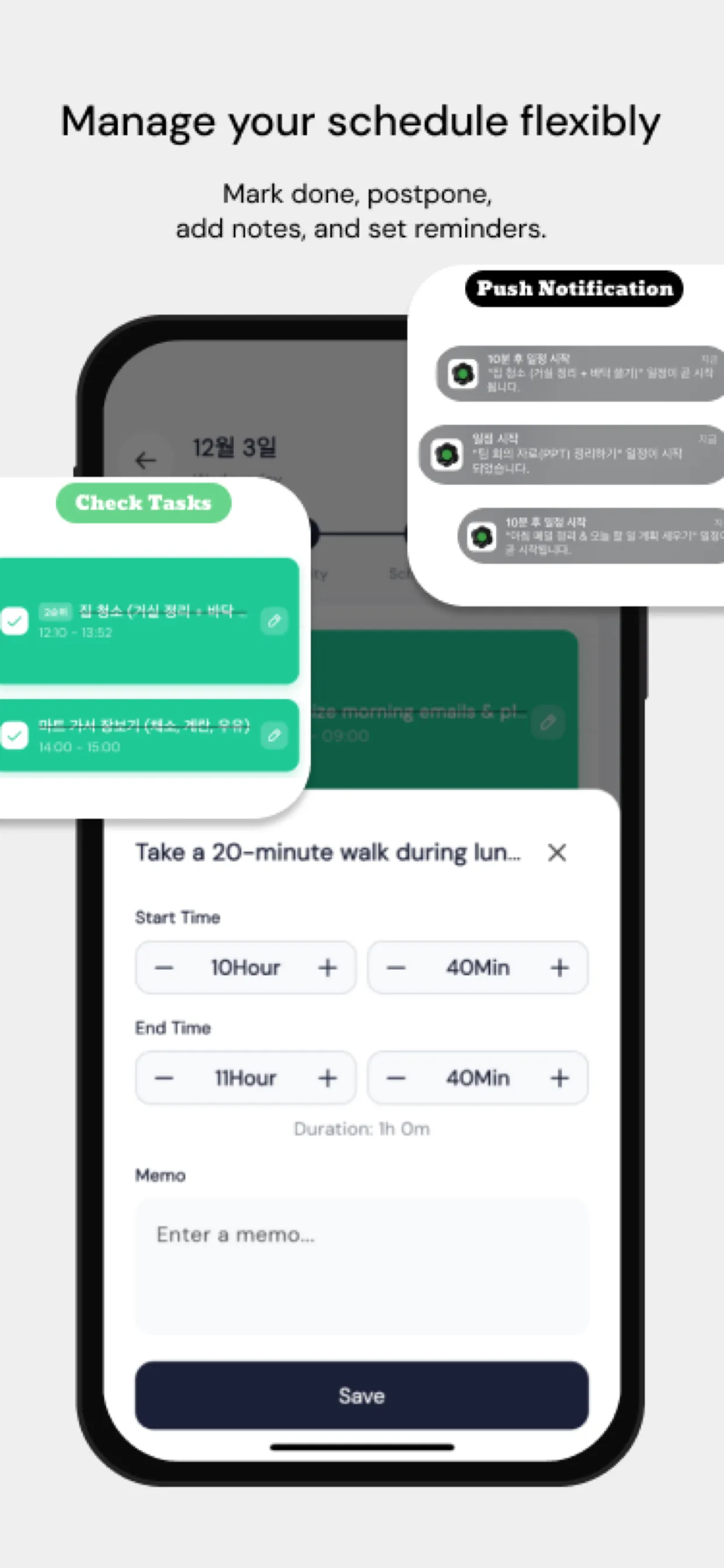
Running this plan in Chrobox
In Chrobox, add each study block as a task and place it on the day timeline with its start time and length, for example "Calculus practice exam 13:00–15:00". When a block starts you get an alert, and the focus timer counts down the two hours once so you can practice exam pacing. Mark the highest-score course as a priority, save the class-day grid as a routine, and use the daily reflection to update your gap list each night. All of that is free; blocking other apps during a study block is a Pro feature.